

Photographing mountain gorillas was one of the main goals of my Uganda photography tour. When designing the itinerary, I knew we shouldn’t rush this experience. So we planned two separate days with the gorillas — not only to optimise our chances of photography, but also to truly absorb the time with our close cousins in the wild.
I intentionally placed Bwindi at the very end of the trip. After days of savannah wildlife, tree‑climbing lions, boat safaris, and endless horizons, it felt right to finish deep in the rainforest. And it proved to be the perfect decision. These two days were, without doubt, the most memorable part of the journey. We were lucky with the encounters, lucky with the light, and lucky with the behaviour we witnessed.
Read on for the full story and photos.
Bwindi Impenetrable National Park
There are a few places left in Africa that feel truly ancient. Bwindi Impenetrable National Park is one of them.
The name says it all. “Impenetrable” is not marketing exaggeration — it is a dense, tangled rainforest draped over steep hills and narrow valleys. Vines hang from giant trees, the air is humid and heavy, and every step off the main trail feels like entering a green labyrinth. This forest is believed to be over 25,000 years old, making it one of Africa’s oldest and most biologically diverse rainforests.
Bwindi is home to nearly half of the world’s remaining mountain gorillas. Thanks to long‑term conservation efforts, anti‑poaching patrols, veterinary support, and carefully managed tourism, their numbers have slowly increased over the past decades. It is one of the rare conservation success stories in Africa — fragile, but hopeful.
The park is divided into several sectors, each with habituated gorilla families that visitors can track. We stayed in the Buhoma sector, the northern gateway to Bwindi and one of the original areas where gorilla tourism started.
Buhoma Village
Buhoma is not a big place. It’s a small village stretched along a single red‑dust road, perched on the edge of the forest. Lodges, local homes, small shops and schools sit side by side. You feel the presence of the national park everywhere — tourism here revolves around gorillas.
In the afternoons, children walk home from school in their uniforms, women carry bananas or firewood on their heads, and travellers gather on lodge terraces to discuss their gorilla encounters. It has a simple rhythm of life and a quiet sense of pride. The gorillas have changed this community. Tourism provides jobs — guides, trackers, porters, lodge staff — and supports schools and healthcare.
For photographers, Buhoma offers more than just gorillas. The surrounding hills are beautiful at sunrise, often wrapped in mist, and village life provides meaningful human moments if approached respectfully.
Read this article about our visit to a local school in Buhoma.
The Journey from Queen Elizabeth National Park
We drove from Queen Elizabeth National Park to Buhoma, and that transition alone was a story worth telling.
At first, the road cuts through open savannah. Gradually, the landscape begins to change. The flat plains give way to rolling hills. The air feels cooler. Green becomes deeper, richer.
Soon, tea plantations start appearing on the slopes — endless, perfectly trimmed green carpets stretching across the hillsides. We stopped several times along the way. Tea pickers were moving rhythmically through the fields, baskets on their backs. With permission, we photographed quietly and exchanged a few words and smiles. Before leaving, we offered a small donation as a gesture of thanks for their time, which was warmly accepted and appreciated.


As we climbed higher, small farms and villages became more frequent. Banana trees, goats wandering along the roadside, and children waving as we passed. The ubiquitous “hello” accompanied us wherever we travelled in Uganda. The road grew narrower and more winding. You could feel that we were heading somewhere remote.
By the time we reached Buhoma, the forest was already towering above us. Thick, dark, mysterious. The real adventure was about to begin.
Photographing Mountain Gorillas – Habinyanja Family
Our first gorilla tracking day was finally here.
We arrived early at the park headquarters in Buhoma, but we were definitely not the only ones. Several vehicles were already parked outside, and travellers from all over the world were gathering with a mix of excitement and nervous energy. Before the briefing, we sat down to enjoy traditional dancing and singing by members of the local Batwa community. So much rhythm, energy and pure joy.
Then came the ranger briefing. Clear rules, no nonsense: keep distance, no flash, masks on near the gorillas, move slowly, follow instructions. It may sound strict, but once you understand how fragile these animals are — and how easily they can catch human diseases — it makes perfect sense.
We were assigned the Habinyanja gorilla family for the day. Our starting point was more than an hour’s drive away, so we jumped back into the vehicles, accompanied by an armed ranger. The drive itself was already an experience. We passed small farms, banana plantations and clusters of simple homes. A couple of times, we stopped, chatted with local people and made a few respectful portraits. I also bought a few beautifully carved wooden gorilla figures — simple souvenirs, but made with real craftsmanship.


Then it was time.
We met additional rangers and porters at the trailhead. Trousers tucked into socks (fire ants are no joke), backpacks adjusted, cameras checked. The trail was steep from the beginning. Thick vegetation, uneven ground, humidity rising with every step. After about 30 minutes, we reached a small stream. I expected wet boots — but no. The porters carried each of us across one by one. A small luxury in the middle of the jungle, and a good reminder of how valuable these guys are. If you visit, hire a porter. It supports the local community and makes your life much easier.
As soon as we crossed, our ranger turned around and said quietly, “Masks on. Leave your backpacks here. Let’s go meet the gorillas.”
And suddenly — there they were.
I was honestly surprised by how quickly we reached them. Just behind a curtain of bushes, the first female appeared, calmly stripping branches and eating the soft inner core with incredible dexterity. The forest went silent except for the sound of tearing vegetation and our cameras clicking.
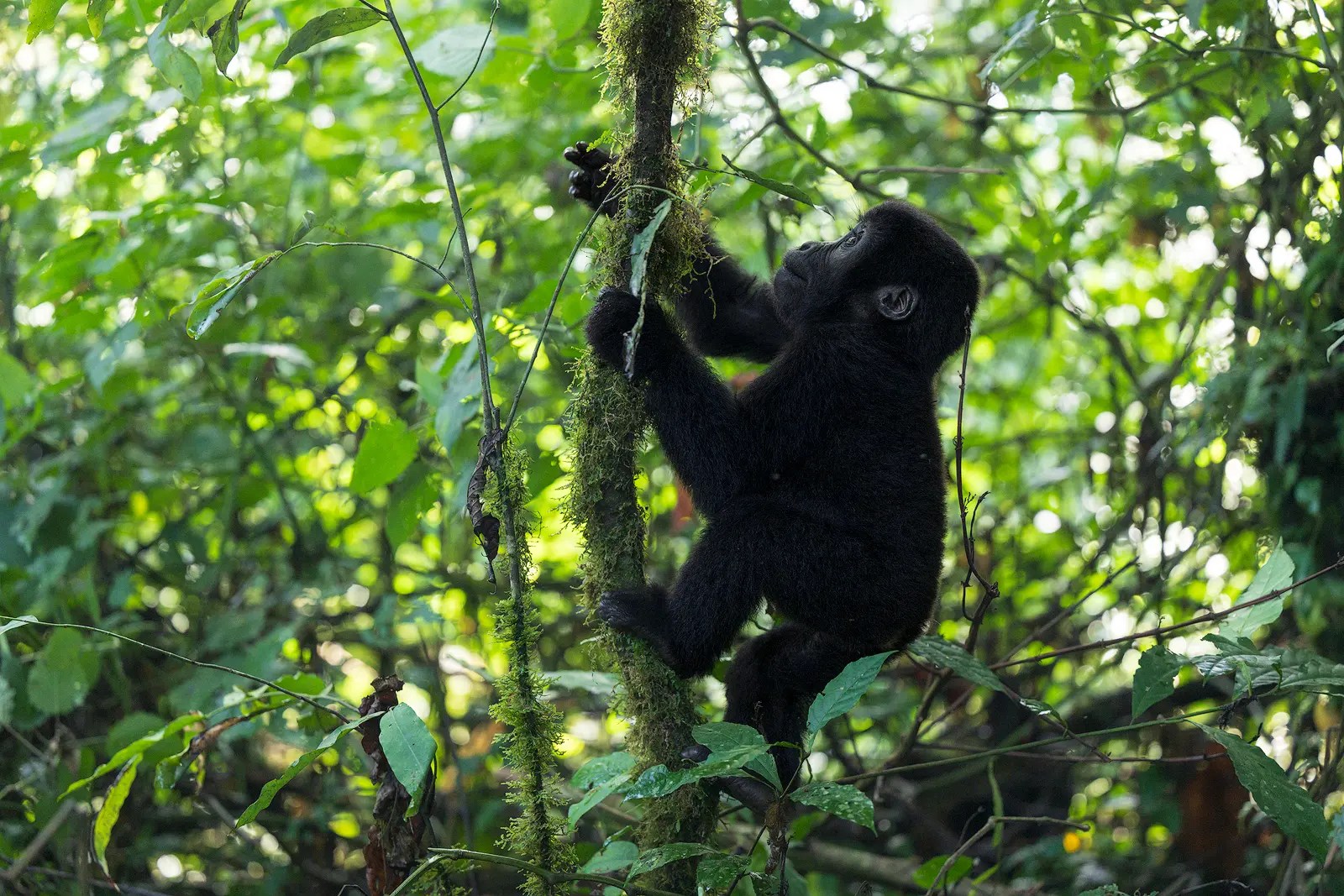
Then a baby gorilla tumbled into view.
Less than a year old, a little male, still clumsy and curious. He climbed, slipped, played and explored, occasionally glancing at us with big, inquisitive eyes. The cuteness level was off the charts. For the next hour, we were fully immersed in something that is very hard to describe. Eye contact with a wild mountain gorilla is not like photographing wildlife on the savannah. It feels intimate. Personal.
From a photography perspective, the conditions were challenging — dense foliage, changing light, high ISO — but incredibly rewarding. I found myself lowering the camera more than once, simply watching. At one point, the baby came so close he could have grabbed my lens. That is when you realise how important it is to stay calm and follow the guide’s instructions.
All too soon, the hour of photographing mountain gorillas was over.
On the hike back, we were buzzing with emotion, replaying moments, laughing, and exchanging impressions with our guides. Back at the trailhead, our ranger organised a small certificate ceremony. A simple printed paper — proof of an experience few people on this planet will ever have.
A few young boys were waiting nearby, selling handmade souvenirs. We chatted for a while and inevitably ended up talking about football. They knew most Slovenian players competing in international leagues. Small world indeed.


Driving back to Buhoma, still processing everything, I suddenly asked the driver to stop. Near a small pond, a group of great blue turacos were moving through the trees. What a bonus! Luckily, most of us still had our cameras ready, so we managed to capture a few frames of these magnificent birds before they disappeared into the canopy.


Photographing Mountain Gorillas – Mubare Family
After such an incredible first day, we all agreed it would be hard to top that experience. And strangely, that felt liberating. I told the group in the morning: no expectations today. Whatever we get is a bonus. Let’s go in with open minds.
At the headquarters, we already knew the routine. A different folklore group was performing — just as passionate and full of life. Today, we were assigned the Mubare family. Even better, our hike would start directly from the HQ. No long drive.
This time the walk was longer. Almost an hour and a half uphill, with a steady but manageable pace and several short breaks. Hiring a porter was definitely the right decision. I carried only my camera with a 70–200mm lens, ready to capture forest details along the way. My backpack was carried by a young man named Denis. Because of that, I could truly enjoy the forest — the textures, the filtered light, the sound of insects and distant birds. I would love to spend an entire day here, just photographing the rainforest itself!
As we climbed higher, the forest changed character. The canopy opened up slightly, while the ground-level vegetation became thicker and more tangled. You could feel we were entering prime gorilla territory. Soon, our guides stopped and quietly prepared us for the encounter.
The light, however, was tricky. Bright, harsh sunlight pierced through the canopy, yet it was still very dark. Classic rainforest contrast, which made photographing mountain gorillas a challenge. I advised the group to raise their ISO — 6400 or higher if needed, to expose for the gorillas’ faces, and to be careful with blown highlights where sunlight created natural spotlights. In conditions like this, flexibility matters more than perfection.
The Mubare family consists of six members: one dominant silverback, four females and a two‑year‑old juvenile male. Just like the previous day, the youngster quickly stole the show. Being older than the baby we saw on Day 1, he was far more agile and confident. He climbed branches above our heads, jumped onto the silverback’s back, wrestled playfully with his older sister, and even attempted short chest‑drumming performances. Pure entertainment.
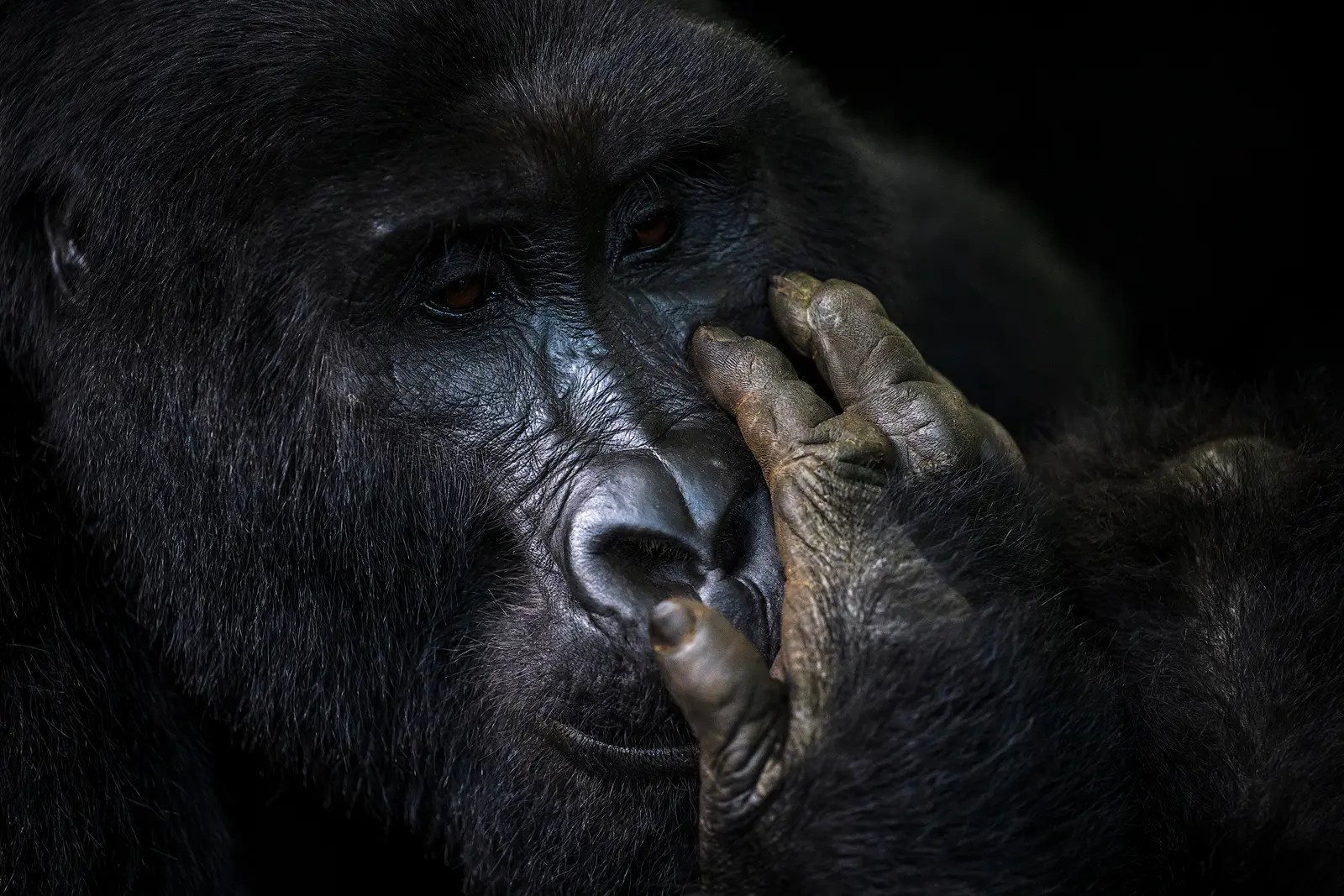
And yet, what struck me again was the gentleness. The silverback — a mountain of muscle, the very definition of raw strength — moved calmly, almost softly. No aggression, no tension. Just quiet authority. Watching him interact with the group was a lesson in leadership without force.
For most of our allotted hour, I simply sat on the forest floor, observing. It is surprisingly easy to be fully present in moments like this. The cameras click, but the deeper experience happens when you lower them.
Later, as the sun shifted, the light softened slightly, and we managed to capture a few beautiful frames as well. Soft expressions, layered jungle backgrounds, natural behaviour.
And just like that, our second hour with the gorillas was over.
Walking back down the trail, I felt less adrenaline and more gratitude. Instead of reviewing images in my head, I was looking at the forest itself — the leaves, the tree trunks, the shifting light. Two days, two families, two completely different moods. Both unforgettable.






Mountain Gorillas of Bwindi Impenetrable Forest – Conclusion
Photographing mountain gorillas was the personal highlight of my trip to Uganda — and I believe it was the same for everyone in our group.

Spending time so close to them, quietly immersed in their world, can genuinely change you. But only if you let it. You have to drop expectations, forget the perfect shot for a moment, slow down and simply observe. In that space, you start noticing the simple rhythm of their lives: foraging for food, resting, grooming, playing, socialising. A strong family structure. Clear hierarchy. Connection. In many ways, it feels like a reminder of something we humans have gradually lost.
I am truly glad that gorilla tourism in Uganda is organised the way it is. Permits are limited, rules are strict, rangers are professional, and the system clearly supports conservation. The gorillas benefit. The forest benefits. The local communities benefit through jobs and income. And visitors walk away with an experience that goes far beyond photography. It is a delicate balance — but right now, it is one of the best conservation models in Africa.
If you are travelling through Uganda, take the time to visit Bwindi responsibly. And if you would like to experience it with a small group of like‑minded photographers — combining gorillas with savannah wildlife, tree‑climbing lions, abundant birdlife and authentic cultural encounters — you are more than welcome to join one of my future Uganda photography tours.
Read more stories from Uganda on the blog, and feel free to reach out if you have questions about gorilla tracking or photographing in rainforest conditions.


