

Telus announced today that it "is beginning to deploy" its 3.5GHz mid-band 5G airwaves in Toronto, Montreal, Edmonton, Ottawa, and Victoria. With Rogers' network in Nanaimo, that now makes six cities getting the fast new form of 5G.
Telus follows Rogers and Bell, which announced their new 5G earlier this week. While all three carriers already have some form of 5G, the new networks will have wider bands of spectrum devoted to 5G and thus offer faster performance.
The 3500MHz 5G airwaves were auctioned off earlier this year. Service will initially come to major cities, based on a plan where the government makes the airwaves progressively available to the carriers in different parts of the country. (There's an official map here.)
"As Telus continues to deploy its new spectrum through 2022 and 2023, more regions will gain access to its increasingly responsive network and faster speeds enabling the next wave of 5G capability, driving further innovation and growth within Canada’s digital economy," Telus said.
While Bell's announcement focused on consumer smartphones, Telus' press release, like Rogers', talks about new commercial and industrial uses of 5G.
"Telus’ 3500MHz spectrum will enable the next wave of 5G capabilities ... powering important advances in health, agriculture, energy, transportation, and manufacturing. As artificial intelligence, virtual reality, smart vehicles and smart city capabilities are strengthened through this mid-band spectrum," the release says.


Home internet users will also benefit. "Canadians living in some rural and remote communities are also some of the first in the country to access home internet speeds of 100Mbps through Telus' 5G fixed wireless network, using the capabilities of 5G to provide a powerful alternative to a wired internet connection," the release says.
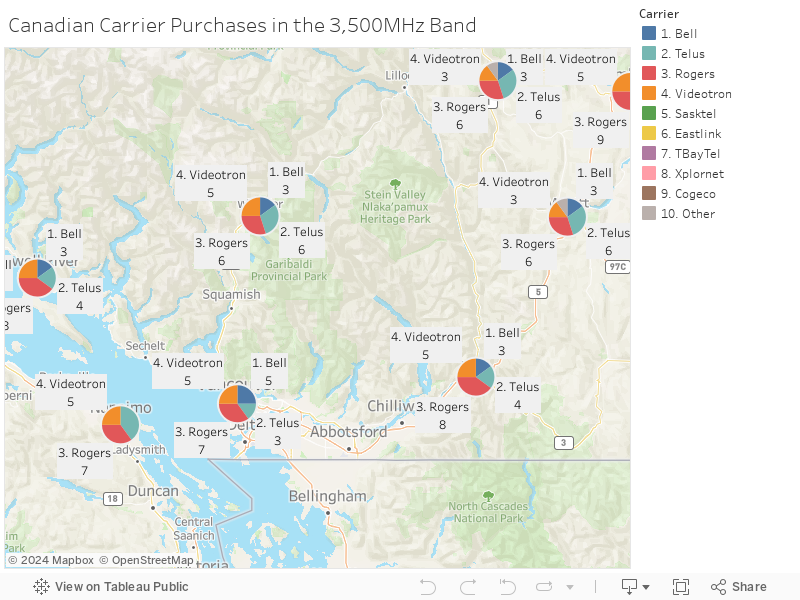
Videotron, Xplorenet, and others also all have 3500MHz airwaves, and so they're anticipated to launch service on them as well. The map below shows who has how much and where.
Telus and Bell share spectrum, so in general, where Telus installs its network, Bell customers will get access, and vice versa.
But the phones that support it will initially be different on each carrier. In general, the network will work with phones that support frequency band n78. Telus says the Apple iPhone 12, 13, and SE 2022 will get access first, with "select Samsung devices" getting it "later this year." Bell, on the other hand, called out the Google Pixel 6, Samsung S21, and S22, and "other select devices."
We're planning to drive around Canada in August to test the new networks for our Best Mobile Network Canada feature.