

The United States—and the world—is plagued by dumb, stupid laws—so many in fact that there are two websites dedicated to the most ridiculous: Dumb Laws and Stupid Laws. But one area those sites don't get into much is technology.
Whenever you're out and about using a laptop, smartphone, or tablet, you could—and probably are—breaking one of the laws listed below. Sometimes the regulations test how we as end-users live and work with our tech on a daily basis, and how we evolve our usage as the technology changes.
Frequently the issue is ambiguously written rules and codes, which makes it all the easier to trap you into something never actually intended by lawmakers. Not that law enforcement is going to complain about such vagueness in the law books—such things helps catch the dumber bad guys.
It doesn't help that we as a society are expected to put up and shut up. We live in a surveillance culture where people supposedly shouldn't be concerned "if they have nothing to hide." It also doesn't help that we have created a social sharing culture that has made privacy a non-issue to so many, even as we learn more about programs like the NSA's PRISM that data mine our calls, emails, and texts.
Regardless of the intentions for these laws their execution leaves something to be desired. So keep in mind, the laws as put forth by our Congress (or your local statutes) are real and you very well might be breaking them unknowingly. And maybe you should break them, for only then does change happen. Just look at segregation, anti-miscegenation laws, and DOMA—not to equate those amazing bits of equal/civil rights with a law that prevents you from using someone's Wi-Fi, but you get the point.
Read on for five offenses you didn't know were illegal and start prepping your defense should you need one. Maybe your case could change one of these dumb, redundant tech laws for the better.
1. You Used Unsecure "Free" Wi-Fi Connections
We've all needed to go online and found a stray Wi-Fi signal to connect to, right? Sure. And while that's not a smart thing to do security-wise—you should only connect to a network you trust, Chester—it's also pretty damn convenient. So-called "Wi-Fi squatting," however, could get you prosecuted under the Computer Fraud and Abuse Act of 1986. That law makes it a felony to knowingly access computer systems without prior authorization. This includes Wi-Fi networks.
Don't think it could happen? A man from Sparta, Michigan once had to pay a $400 fine and do 40 hours community service for sitting outside a café using its Wi-Fi from his car. The cops and café weren't even sure he was doing something wrong, but the district attorney decided he was. It's happened in other states as well.
The key word is "knowingly." And as more and more Wi-Fi signals get secured, you could argue that anyone with an unlocked network broadcasting an SSID knows the signal is going to be seen and used. In fact, operating systems like Windows XP can auto-connect to the nearest, strongest Wi-Fi network. Turn that feature off.
If you do anything extra-illegal on an open connection, expect to pay extra fines if you get caught. (Local businesses should check and make sure their own local statutes don't require them to secure their Wi-Fi signals, too, or face their own potential fines.)
2. You Copied or Installed Software
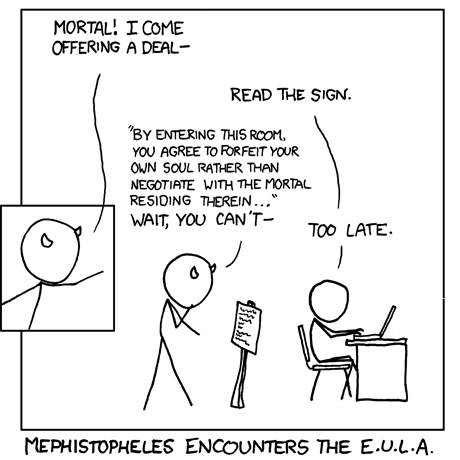
Whenever you install software or join an online service, you are shown Terms of Service (ToS) or an End-User License Agreement (EULA)—recognizable as all that lawyer-speak gobbledygook you scroll past without reading before you click "I read it!"
It may not technically be "illegal" to break with those agreements, but it is breaking a contract, for which you can be sued.
The most likely way you've broken an EULA is copying your software and passing it on to others. You don't have that right. It's one of the reasons software companies are thrilled to become "services companies"—you can't illegally copy a Web app.
Other ways you may have broken an EULA: installing software on a system where it's not allowed. For example, for several months the original EULA for Safari browser on Windows said it could only be installed "on a single Apple-labeled computer." Installing multiple copies of Windows from a single disc is also against the rules. By the way, EULAs often include a clause making it totally OK for them to change the rules whenever they want. So there.
3. You Downloaded a Movie, TV Show, or Song
Try to convince anyone under the age of 30 that downloading popular media is a crime and they'll probably look at you dumbfounded. "Copyright infringement? Online piracy? But I totally wanted to watch R.I.P.D. on my laptop in bed!"
Look, there's free and then there's free. If the actual copyright owner says you can have it free and supplies it, then no harm, no foul. Retailers like iTunes and Amazon make free music available all the time through agreements with publishers and artists. Some argue having their works out there for free increases the paying audience. Just ask Cory Doctorow, sci-fi author and BoingBoing blogger, who gives away free electronic editions of all his books. He has the right to do so (and the platform to make it worthwhile).
Grabbing books, music, movies, and TV shows indiscriminately off the Internet—which is the backbone of BitTorrent traffic—means you're probably doing so illegally. Chances are you won't get caught because so many other people do it, but if you do get nailed, your ISP could throttle your Internet speed. Worse, industry lobbying groups like the RIAA and MPAA could sue you for millions of dollars, i.e. much more than it's worth to have a few Miley Cyrus songs or bad summer flicks on your hard drive. The RIAA, in particular, gets a little crazy sometimes. Stick to using Spotify and Netflix if you want to be safe.
4. You Unlocked a Smartphone, or Jailbroke a Tablet
The Digital Millennium Copyright Act of 1998 (DMCA) is supposed to prevent people from getting around digital rights management (DRM), which seeks to prevent piracy of everything from music downloads to DVDs to ebooks. DRM is a joke (see "Download a Movie, TV Show, or Song" above if that's a news flash), but the DMCA also has other, more draconian elements.
The DMCA has been amended a few times, and the Librarian of Congress (LoC) can always make exemptions—such as when a technology comes along that needs some leeway. For example, wireless telephone handsets that execute software applications (we call them smartphones) had an exemption for a while. But in January 2013, that exemption lapsed, and it became illegal to unlock a phone purchased after that point.
Unlocking your phone means you give it the option to work on all carriers. Perhaps it's not a big deal with new iPhones, which work on any carrier (you just need to break your inevitable two-year contract with a carrier to move). And it's not the same as jailbreaking (with iOS) or rooting (with Android devices), where you open your operating systems up to doing things the original manufacturer didn't intend, like "side-loading" apps from other stores. As of 2012, the LoC provided an exemption allowing the jailbreaking of iPhones, but didn't allow jailbreaking of tablets like the iPad. Why? Because the definition of tablet in the proposed exemption was "too vague." That's pretty rich, considering the government loves nothing more than making these kinds of rulings as clear as mud.
This all comes up for review again in 2015, so get ready to email the LoC.
By the way, because Apple hates it when you legally jailbreak an iPhone, it voids your warranty if you do so. But guess what? If something goes wrong, restore the phone using iTunes and the company will be none the wiser if you keep your mouth shut.
5. You Had Fun on Work Computers
In a footnote to an Atlantic story on the illegality of unlocking your phone, the author quotes from United States v. Nosal that under a "broad interpretation of the [Computer Fraud and Abuse Act (CFAA) you could be prosecuted for personal use of work computers]."
Remember that ruling above, where lawmakers threw out a request because the definition of tablet was too vague? Here's a law written in such a way that it could be broadly used to prosecute anyone who watched a YouTube video at work—as if it was a federal crime!
OK, the guy in question, Nosal, did get his buddies at his old work place to log into the system and get him info, so he wasn't exactly Mr. Innocence, but this law was not the one to apply. Thankfully, the Ninth Circuit ruled that CFAA would not be in violation in such cases, saying "we hold that the phrase 'exceeds authorized access' in the CFAA does not extend to violations of use restrictions. If Congress wants to incorporate misappropriation liability into the CFAA, it must speak more clearly." If only we could make all laws so transparent.
Anyway, you can go back to YouTube...for now.